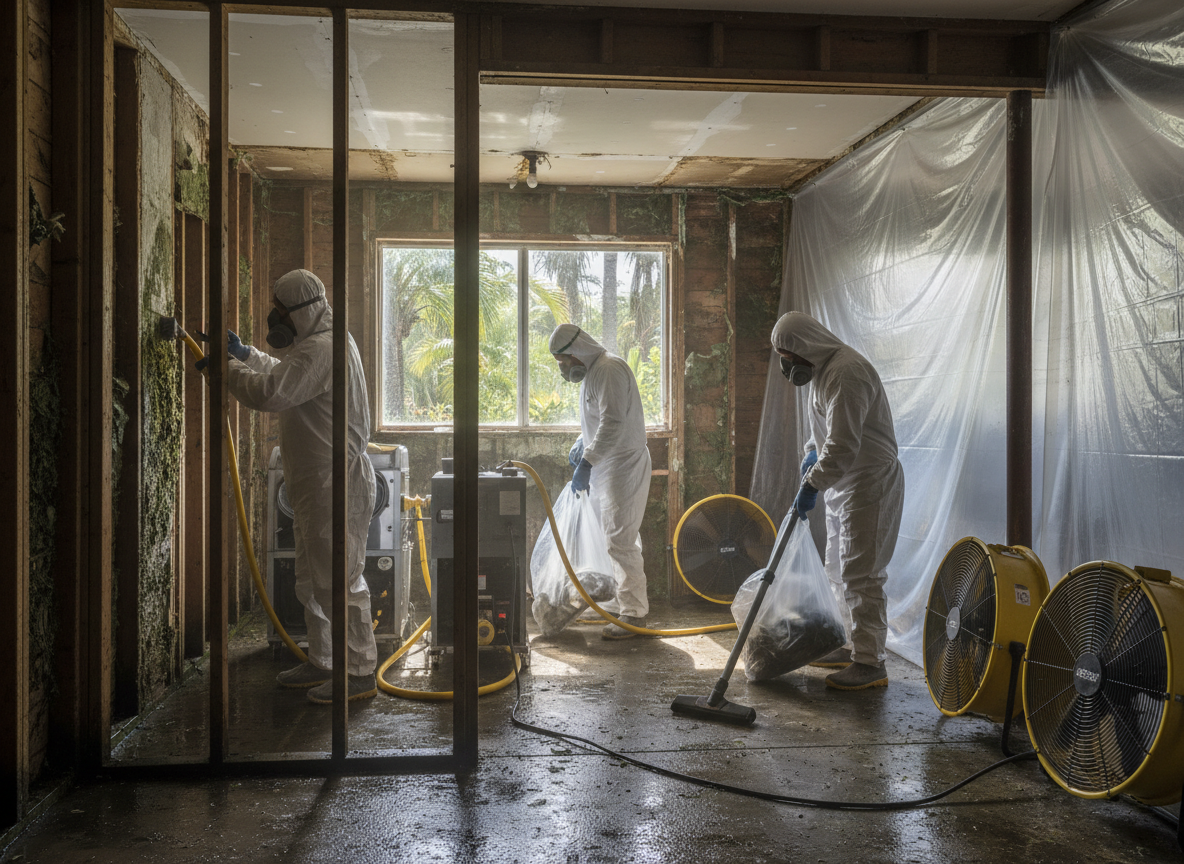
Mold in a Fort Lauderdale home usually announces itself by smell before it is ever seen. A closet that smells like a wet basement. A musty edge when the air conditioning starts. A dark bloom along the top of a bathroom wall that keeps returning after every cleaning. The growth is the visible part of a moisture problem that has been running quietly, often in a cavity, a ceiling pan or a wall base that nobody has read with a meter. Mold remediation in Fort Lauderdale only holds when that moisture is found and corrected.
Why Fort Lauderdale owners call us for mold work
Mold work fails for predictable reasons: the moisture source is never found, containment is skipped, or the job is called finished because a wall looks clean. Those are the points we build the job around.
The source comes before the treatment. Cleaning growth while the leak, the condensate line or the wall base is still wet buys a few months. The first visit is about finding where the water is coming from and whether it is still arriving, then agreeing the repair that belongs to a plumber, a roofer or the building.
Containment is not optional. Disturbing a contaminated surface without containment spreads spores into rooms that were clean. Poly barriers, negative air pressure and HEPA filtration are set up before removal begins, and the work area is checked before it is taken down.
Removal is decided by material, not by appearance. Porous material that has been wet long enough comes out; solid material that can be dried and cleaned stays. The scope names which is which, so you are not paying for demolition that was not needed or keeping material that cannot be saved.
The finish is judged on readings and a walkthrough. Moisture content is compared with a dry standard, the work area is inspected, and the findings are written down. If the cause was never fixed, we say so plainly rather than treating the same wall twice.
What mold remediation should actually involve
The word remediation is used loosely in this trade. Some companies treat it as a spray-and-wipe visit. What it should mean is a contained removal of affected material, a correction of the moisture source and a documented end point. Here is what we do, and what we will not pretend to do.
We find the moisture before we touch the growth. Mold does not grow on a dry surface, so the first task is to establish why that wall, ceiling or cabinet is wet. That means readings, a thermal scan where the area is concealed, and a conversation about what changed: a storm, a leak from above, a bathroom fan that stopped working, an air handler that has been overflowing into a pan. Remediation without that step is a cleaning, and the growth returns within a season.
We contain the work area. Doors are sealed, openings are taped, and where the affected area is large or the growth is disturbed by removal, we run HEPA filtration with the work area under negative pressure so spores do not migrate through the house. Containment is not decoration; it is the difference between removing growth from one room and spreading dust through five.
We remove what cannot be cleaned. Porous material — drywall, insulation, ceiling tile, carpet, the paper facing on studs — cannot be reliably cleaned once growth has penetrated it, and we say so instead of treating it. Hard surfaces can be cleaned and dried. What we do not do is apply a coating over growth and call it encapsulated.
We correct the source, or we name the trade that must. A failed pan, a blocked condensate line and a leaking supply line are ours to identify. A roof, a window, a slab leak or a bathroom that needs re-grouting may belong to someone else, and we write that hand-off down.
We finish with readings and a visual verification, not a promise. We do not claim a building is sterile, and we do not sell an air test as proof of our own work.
Why mold work in Fort Lauderdale cannot be scheduled for later
South Florida's indoor air is a growth environment for most of the year. Air conditioning runs almost continuously, which keeps interiors cool but also keeps relative humidity high whenever the system cycles off, and any surface that is cool and damp stays that way. Add a wet wall cavity, a leaking ceiling pan or a bathroom with no working exhaust and the conditions are already met.
Growth does not need a flood. It needs moisture, organic material and time, and in this climate the time is short. The common calls we take are not dramatic: a ceiling stain from a storm three weeks ago, a closet behind a shower, the base of a wall below a sliding door, the paper facing of drywall in an air-handler closet. Each of those was a small water problem that nobody dried.
Hurricane season, from 1 June to 30 November, compresses the timeline further. When a storm pushes water into a house, the same week usually brings more rain, higher humidity and a saturated ground, so materials that would dry slowly elsewhere do not dry at all. The April 2023 flood in Fort Lauderdale left many homes with water in the wall base for days after the street had cleared, and the mold calls arrived weeks later.
People also notice the effects at home before they notice the cause. Some occupants report irritation, a cough or a smell that gets worse in one room; others notice nothing at all. We are not medical professionals and we do not diagnose anyone. What we can say is that the building has a moisture problem, that growth follows moisture, and that removing the growth without correcting the moisture is a repeat job.
The practical cost of waiting is not just the remediation. Material that could have been dried and kept has to be removed. Cabinets, baseboards and door casings that could have been saved are replaced. A contained job in one room can become a containment in three rooms with contents packed out. The earlier the moisture is read, the smaller the scope.
What you can check before you book mold remediation
Mold Remediation Fort Lauderdale Florida operates from 708 SE 32nd St #202, Fort Lauderdale, FL 33316, in Broward County. The number to call is (954) 707-5047, and it reaches the same business address shown in the footer of every page here.
The services are exactly three: mold remediation, water restoration, which includes water extraction and water repair, and storm damage, which includes water leak detection. If a job needs something outside that list, we will tell you rather than stretch the description.
The areas are Fort Lauderdale and eight Broward County cities: Wilton Manors, Oakland Park, Lauderdale-by-the-Sea, Dania Beach, Lauderdale Lakes, Lauderhill, Hollywood and Plantation. Each is within roughly seven miles of the address above.
We do not publish certifications, licence numbers, insurance certificates, a founding year, staff biographies or customer reviews, because none of those are facts this business has given us to state. We also do not present an air sample as proof of our own work. If you want independent clearance testing, that is a separate specialist service, and we will tell you honestly on the call what we can and cannot do about it.
A beachside condo after a ceiling leak from the unit above
The Galt Ocean Mile is a strip of high-rise buildings along A1A in Fort Lauderdale, most of them built between the 1950s and the 1970s, sitting between the beach and the Intracoastal. The construction is concrete frame and slab with block infill, and the interior partitions are often furred drywall over block with a ceiling plane that hides the plumbing and the air-conditioning lines for the unit above.
A call from a building like this usually starts the same way. A stain appears on the ceiling of a bedroom or a hallway. The owner of the unit above has had a water heater replaced, or a shower pan repaired, or a supply line behind a vanity fixed. The leak is supposedly over. Three weeks later the stain has a dark edge, and the smell arrives.
What makes this different from a house is that the wet assembly belongs to more than one person. The ceiling drywall may be the lower unit's responsibility while the pipe above and the slab belong to the building or the upper owner. Cutting an opening without telling anyone creates a dispute that outlasts the repair. Our first step is to document the stain, read the ceiling plane and the wall base with a meter, and identify whether the moisture is in the drywall only or has reached the block and the cavity behind it.
The second difference is containment. In a sealed high-rise with a shared corridor and a recirculating air system, disturbing growth without containment sends dust into a space you do not control. We seal the doorway, run HEPA filtration under negative pressure, protect the corridor and bag material out rather than carrying it through the lobby.
The third is access. Removing a section of ceiling in a condo often needs a work order, an association notification or an owner's approval, and the building may want the work done inside set hours. We explain the opening we need and why, so the approval conversation is about a specific cut and not a vague request to open a ceiling.
Finally, the source has to be confirmed on the other side. If the upper unit's pan is still overflowing or the shower still weeps, remediation downstairs is a temporary result. We say what we found, put it in writing and make clear which part of the fix belongs to the building and which belongs to an owner.
Where mold in Fort Lauderdale usually starts
Four locations account for most of the growth we are called to. Each is a moisture trap rather than a cleaning failure, and each one needs the water corrected before the growth is removed.
The air-handler closet and its condensate pan
The component is the air handler, its evaporator coil, the primary condensate drain and the secondary pan under the unit. In a Fort Lauderdale home the system runs for most of the year, so it produces condensate every day and the coil stays wet. When the drain line clogs with algae, water backs up into the pan and then onto the platform, the closet floor and the ceiling below. What you notice is a musty smell at the supply registers, a dark line along the closet baseboard, or a rust ring on the platform. The paper facing of the drywall in that closet absorbs the moisture first and supports growth within days. First move: switch the system off, empty the pan, check the float switch and get the closet read with a meter before the unit runs again.
A bathroom exhaust that vents into the attic or nowhere
The component is the exhaust fan, its duct, the roof or wall termination and the backdraft damper. A fan that moves air into the attic, into a soffit void or into a length of flex duct that has come loose is worse than no fan, because it delivers warm, wet air into a dark, still space. Some older Fort Lauderdale bathrooms have no duct at all. What you notice is peeling paint above the shower, a musty smell that clears when the window is open, or dark speckling at the ceiling edge. First move: confirm where the duct actually terminates, not where it is supposed to, and stop using the fan until it is corrected. Removing growth from a bathroom ceiling without fixing the exhaust produces a repeat within a season.
The wall base below a sliding door or window
The component is the door or window sill, the track, the weep holes and the wall assembly below the opening. Wind-driven rain and irrigation both reach this area, and the wall base stays damp because it is the lowest, least ventilated part of the wall. In older construction the interior may be furring over block with a small cavity where water collects. What you notice is a swollen baseboard, paint lifting at the corner, a dark line along the bottom of the drywall, or a smell that is strongest near the floor. First move: check the track drainage and the exterior sealant, then read the wall base from the interior. Cleaning the visible growth without opening the cavity leaves the wet material in place.
A ceiling cavity after an upstairs leak
The component is the ceiling plane, the drywall, the insulation above it and the joist or slab that carries the water from the source. Water entering from an upstairs bathroom, a roof opening or a neighbouring unit travels along the joist or the slab soffit before it stains a ceiling, so the visible patch is rarely above the leak. What you notice is a ring that grows after each rain or each shower, a soft spot when you press the ceiling, or a smell in the room that gets stronger when the door is closed. First move: photograph the stain, keep weight off the ceiling and get the cavity read before anyone cuts. Removing a stained section without confirming the source leaves wet insulation feeding the same joist.
How it works
- 1
Call and initial questions
We ask where the smell or growth is, when it started and what water event came before it. You get a clear idea of what the visit will involve.
- 2
Moisture and extent assessment
We read the affected area and the surrounding assembly, scan concealed areas with a thermal camera where needed, and define the boundary of the work.
- 3
Containment and filtration
Doorways and openings are sealed, HEPA filtration is set with the work area under negative pressure, and contents are protected or moved.
- 4
Removal and cleaning
Affected porous material is removed and bagged out, hard surfaces are cleaned, and the cavity is dried and checked before it is closed.
- 5
Source correction and hand-back
We correct what is inside our scope, name the trade that owns the rest, and leave a written record of the readings and the material removed.