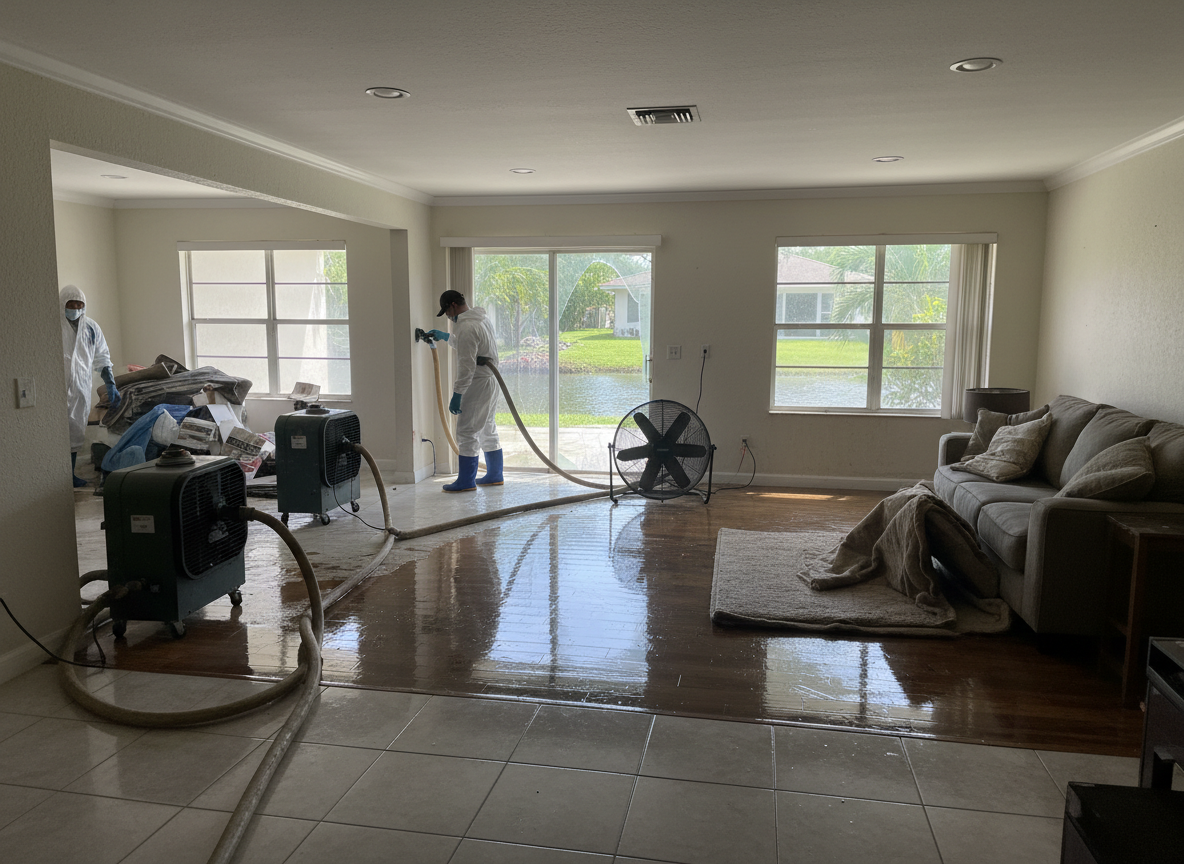
Dania Beach sits on ground that has been built over for more than a century, next to an airport, a port corridor and the Intracoastal. Water problems here often come from two directions in the same week: rain that cannot soak into saturated ground, and tidal water that backs up the canals and stands in low streets. This page explains how we read a Dania Beach building before we scope the work.
What should a Dania Beach homeowner know first?
Dania Beach is an 8.3 square mile city in Broward County with a 2020 population of 31,723, directly south of Fort Lauderdale and next to Fort Lauderdale-Hollywood International Airport. It was incorporated in 1904 as the Town of Dania and took its current name in 1998. About 3 percent of its area is water, and the water that matters most is often underground.
A 1904 town with a mid-century layer on top
The city's housing spans more than a hundred years. The early core grew around the original settlement and the rail line, with small houses that have been added to, re-roofed and re-plumbed several times. Around it, post-war subdivisions and 1960s and 1970s apartment buildings filled in, and more recent townhouse and condo projects followed. In one house that means original galvanised supply lines feeding a 1980s bathroom, a flat roof over an addition and a slab that has been patched. When water enters a building like this, it finds the oldest joint first, and the repair history is part of the diagnosis.
Airport land, paved surfaces and a managed canal system
Dania Beach shares its boundary with a major airport and a port corridor, and much of the surrounding land is paved. Runways, aprons, warehouses and parking areas shed rain quickly, and that water enters the same canal and drainage network that serves the city's streets. When a slow storm sits over the area, the network is carrying runoff from far more than the residential blocks. For a homeowner, the practical effect is a street that floods from water generated elsewhere, and a wall base that gets wet even when your own roof and yard drained normally.
Two directions of water: the Intracoastal side and the inland side
The city stretches from the Intracoastal side east of the rail corridor to inland blocks toward Davie and the Seminole reservation boundary. Water arrives differently at each end. Near the water, tidal backup and storm surge push into canals and low streets. Inland, the problem is rainfall that cannot infiltrate because the water table is high and the ground is already full. A property in the middle can get both: a canal-backed street on one side and a saturated lot on the other. We ask which direction the water came from before we decide what has to be removed.
Who serves a Dania Beach address
Dania Beach is its own municipality, so building permits and local drainage questions run through the city. Broward County publishes the flood maps used for insurance and runs countywide emergency management, and the regional canal and drainage network is managed at the water management district level. Because the city borders airport and port property, a drainage question can also involve another authority. We document the building and point you to the office that owns the record rather than guessing at it.
What does a Dania Beach property need?
Three patterns cover most of the work here: storm or tidal water at a wall base, rain finding a roof or window edge on an older building, and growth in a cavity that stayed damp after either. The age of the assembly decides how much can be dried and how much has to come out.
- Water restoration covers extraction, drying and the repair work that follows. In Dania Beach the first question is usually whether the water came in from the street or from above, because the two produce different contamination and different documentation.
- Storm damage covers wind and rain intrusion on roofs, openings and lanai ties, with leak detection included so the entry point is identified before material is removed.
- Mold remediation is the right service when a wall, ceiling pan or cabinet base has stayed damp long enough for growth. Containment, removal and source correction come in that order.
A job near the water often starts as storm damage and ends as water restoration once the source is closed. A job inland usually starts as water restoration and turns into remediation if the cavity has been damp for weeks.
Why choose a Fort Lauderdale crew in Dania Beach?
Our base at 708 SE 32nd St in Fort Lauderdale is about three miles north of Dania Beach, which makes it one of the closest cities we cover. We work in older housing every week: 1904-era cottages that have been extended, post-war block ranches and 1970s apartment buildings with original drains. We read moisture before removal, write the scope before work starts and name the trade that owns a source repair. This site does not publish licence numbers, certifications or reviews, and we do not invent them to fill a page.
Why Dania Beach water damage should be dealt with now
The ground here is often already full before the rain starts. Dania Beach sits low, the water table is high, and a large share of the surrounding land is paved, so a storm has very little ground left to absorb. Water that cannot soak in stands in streets and presses against wall bases, and once drywall and baseboard have absorbed it, the humidity in this climate keeps them damp. Hurricane season runs from June through November, and the autumn king tides add a second path through the canals. A wall that is dried this week is a wall that does not need to be opened next month, and that is the practical argument for calling early.
What should a Dania Beach homeowner check before the next storm?
Dania Beach takes water from the street, the canals and the roof, sometimes in the same week. These four checks help you work out which one you have.
Watch the street, not just the sky. A large share of the land around the city is paved, and runoff from airport, warehouse and port surfaces enters the same drainage network as residential streets. If your street floods on a day with modest rain, the water is coming from somewhere else. Note the level at which it reaches your wall and photograph it.
Check the wall base in the oldest part of the house. Early-1900s houses here have usually been extended and re-plumbed, and the oldest wall is the one that takes water first. Press the baseboard, look at the paint at the corner and check for a damp smell in the room closest to the street.
Look at roof edges and flat-roof additions. A flat roof over an addition, a low parapet or a valley between two roof planes is where water stands before it finds a seam. Clear debris, check the sealant and photograph any ceiling stain that grows after rain.
Check the canal level relative to your lot. If water backs up the canal during a storm, the lowest opening on your property decides whether it enters. That may be a garage door, a pool deck drain or an exterior electrical box, and it is worth knowing before the water arrives.
Once water has crossed pavement or soil, treat it as contaminated until the category is confirmed. That single rule decides what can be dried and what has to be removed.
How a Dania Beach job runs, step by step
Every job starts with the direction the water came from, then moves through drying and documentation to a written hand-off.
- Call and describe the water. Say whether it came in from the street, the ground, a roof or a fixture, and how long it has been there. We explain what to keep clear and what to shut off if it is safe.
- Read the building. Moisture readings at marked points, a thermal scan where a wall or ceiling is suspect, and a dry reference of the same material for comparison.
- Stop the source and protect the rooms. Water is shut off where that is safe, contents move clear and containment goes up where growth or contamination is present.
- Extract, remove and dry. Standing water and saturated material come out, then air movers and dehumidifiers run against daily readings.
- Verify and hand back. Final readings are compared with day one, and repairs that belong to a plumber, roofer or general contractor are listed in writing.
What's included on a Dania Beach job:
- A written scope separating emergency water work from permanent repairs
- Moisture readings at marked points, photographed and repeated at the same locations
- Extraction of standing water and removal of saturated pad, carpet or drywall
- Air movers, dehumidifiers and cavity drying set to the age and build of the assembly
- Containment and HEPA filtration where growth is present or likely
- Photographs and a moisture log for an owner, landlord or insurer
- A hand-back walkthrough with day-one and final readings side by side
What's the next step in Dania Beach?
Call (954) 707-5047 and describe the water: where it is, when it appeared and whether it came from the street, a wall or above. We will tell you what to keep clear, what to shut off if it is safe, and what the first visit will cover. If the source is a roof or a plumbing line, we will say so before you book.
Around Dania Beach
We regularly work near:
- 📍Dania Beach Boulevard
- 📍Intracoastal Waterway
- 📍Fort Lauderdale-Hollywood International Airport
- 📍Dania Pointe
- 📍Hollywood
- 📍Fort Lauderdale
Mold Remediation in Dania Beach — Local Notes
- •2020 population 31,723; incorporated in 1904 as Dania
- •Adjacent to Fort Lauderdale-Hollywood International Airport
- •About 3 percent of the city's area is water