Lauderdale Lakes was built for people who came for the season and left before the summer storms, and its housing still carries that pattern. A unit stands closed for months, a supply line weeps behind a vanity, and the first person to notice is the neighbour below when a ceiling stain appears. This page covers how we read water and mold problems in a city of condos, shared walls and inland rainfall.
What makes water damage in Lauderdale Lakes different?
Lauderdale Lakes is a 3.64 square mile city in central Broward County with a 2020 population of 35,954, incorporated on 22 June 1961. It has almost no coastline and very little surface water — 1.37 percent of its area — so the water that causes damage here comes from rain, plumbing and shared walls rather than tide.
A city built in 1961 for seasonal residents
The city was originally popular as a retirement area for snowbirds, and much of its housing was built to suit that market: low-rise condo buildings, villa clusters and small single-family homes on compact lots. That origin still shapes the work. A unit that is closed for the summer has no one to notice a dripping supply line, a failed water heater pan or a condensate line that has blocked. By the time the owner returns, or the neighbour below complains, the moisture has been sitting in a wall or ceiling for weeks. Buildings of that era also carry original cast-iron drains, galvanised or early copper supply lines and bathroom layouts that have been renovated piecemeal.
Condos, associations and the ceiling above yours
A large share of Lauderdale Lakes calls involve more than one unit. Water from the unit above travels through the slab or the ceiling assembly and appears in a downstairs bathroom or hallway, often far from the fixture that failed. Who authorises the work depends on the building: an owner for the interior of a unit, an association for common elements, sometimes both. We document where the water crossed, what it touched and how far it travelled, because that record is what the owner and the association need to have the same conversation. We do not decide responsibility between them.
Inland rainfall and a flat, saturated city
With no coast and almost no open water, Lauderdale Lakes floods from rainfall that cannot drain away fast enough. The city is flat, built out, and drains through a canal and swale network that has to carry runoff from neighbouring municipalities as well. When a slow storm sits over central Broward, water stands in low parking areas and against building wall bases, and it can enter a ground-floor unit at a door threshold. Because the water table is high, the ground does not absorb much before it stops accepting water altogether.
Who serves a Lauderdale Lakes address
Lauderdale Lakes is its own municipality, so building permits and local drainage questions run through the city. Broward County publishes the flood maps used for insurance and runs countywide emergency management, and the regional canal and drainage network is managed at the water management district level. In a condo building, the association may also have its own rules about work hours, elevator use and contractor access. We plan around those before the crew arrives.
What does a Lauderdale Lakes property need?
Most work here falls into three groups: a leak inside a closed unit that has been running for weeks, storm rain that reaches a ground-floor threshold, and growth in a wall or ceiling that stayed damp after either. The building type decides what can be dried.
- Water restoration covers extraction, drying and the repairs that follow. In a condo, the first step is usually documenting the unit above and below so the record shows where the water travelled.
- Storm damage covers wind and rain intrusion for the buildings here, from a roof edge over a top-floor unit to a door threshold at ground level, with leak detection included.
- Mold remediation applies where a ceiling pan, bathroom wall or closet has stayed damp long enough for growth. Containment and removal come before any source correction.
A closed unit that has been leaking for a month often needs two of those services at once: drying in one unit and remediation in the one below. Both are scoped from readings rather than from appearance.
Why use a Fort Lauderdale crew in Lauderdale Lakes?
Our base at 708 SE 32nd St in Fort Lauderdale is about six miles from Lauderdale Lakes, and we work in low-rise condo buildings and villas across Broward every week. We are used to the approval chain: an owner, a tenant, a manager and an association, each needing the same facts in writing. We read moisture before removal, name the source and put the hand-off to plumbing or roofing in the scope. This site does not list licence numbers, certifications or reviews, and we will not invent them.
Why a Lauderdale Lakes leak cannot wait for the owner to return
A seasonal unit is the worst place for a slow leak, because nothing about it is urgent until it is expensive. A supply line that weeps behind a vanity for six weeks can soak a cabinet, the wall behind it, the floor under it and the ceiling of the unit below. In this climate, that is more than enough time for growth. The same applies to storm rain that enters a ground-floor unit while nobody is there: the water stands, the air conditioning cycles, and the humidity stays high. Hurricane season runs from June through November, which is exactly when many units are closed. A monthly check of the shut-off, the water heater pan and the air handler is cheap; a ceiling assembly is not.
What should a Lauderdale Lakes owner check before the unit stands empty?
Four checks cover most of what goes wrong in a low-rise or seasonal unit here: the shutoff, the hoses behind the vanity, the water heater pan and the condensate line, and who is holding the keys while nobody is home.
Know the shutoff and test it. In a 1960s or 1970s building the unit valve is often behind a panel in a bathroom or closet, and it may not have been turned in years. Turn it, then open a tap to confirm the water actually stops. A valve that will not close is the one thing that turns a small leak into a claim while the owner is away.
Look at the hoses and the pan. Braided supply hoses have a service life, and a washing machine or vanity hose that bulges or feels stiff at the fitting is closer to failing than it looks. Under the water heater, a pan without a drain line, or a drain line that empties onto the floor, sends a slow drip into the slab and the ceiling below.
Clear the condensate line. In a closed unit the air handler still runs, and a blocked condensate line puts water into the ceiling assembly rather than outside. Pour a cup of water through the line and watch it drain; if it backs up, clear it before the season starts.
Agree who checks and who authorises. A unit that is empty for months needs someone to look in, and the association needs to know who can approve work if water appears. Leave a number with a neighbour or the manager and say plainly that a leak is not something to wait on until you return.
Those four checks take under an hour and cover the failures we see most often in Lauderdale Lakes. If water has already appeared, the next decision is about the unit boundary, and that is where documentation starts.
How a Lauderdale Lakes job runs, step by step
Every job starts with the unit boundary and the source, then moves through drying and documentation to a written hand-off.
- Call and describe the leak. Tell us which unit is wet, which unit is above it, and who can authorise work. If nobody is on site, say so, because that changes the plan.
- Read both sides. We take moisture readings in the affected unit and, where access allows, the unit above, comparing each with a dry reference of the same material.
- Protect the building. Contents are moved clear, the work area is contained where growth is present, and the route in and out is agreed with the manager or association.
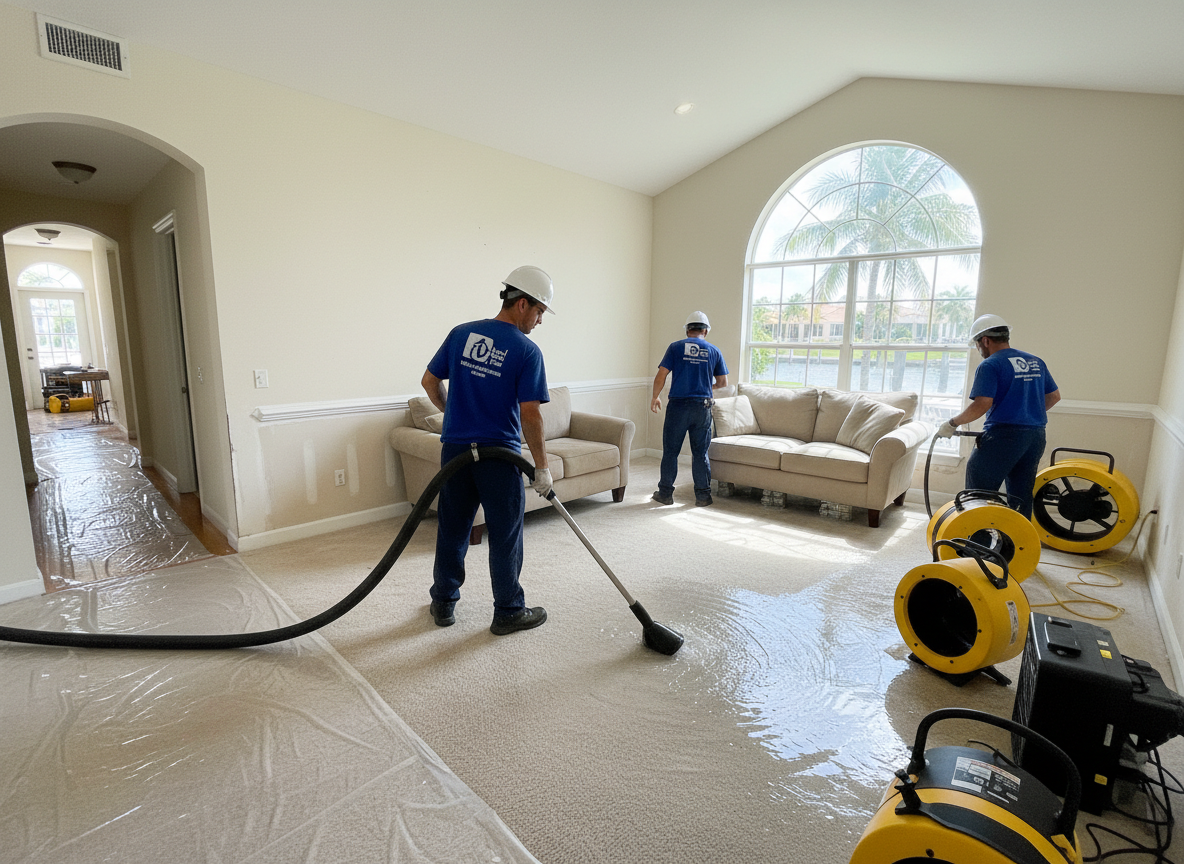
- Extract, remove and dry. Standing water and saturated material come out, then air movers and dehumidifiers run against daily readings.
- Verify and hand back. Final readings are compared with day one, and the repairs that belong to plumbing, roofing or the association are listed in writing.
What's included on a Lauderdale Lakes job:
- A written scope separating emergency water work from permanent repairs
- Moisture readings in each affected unit, photographed and repeated at the same points
- Extraction of standing water and removal of saturated pad, carpet or ceiling material
- Air movers, dehumidifiers and cavity drying suited to a low-rise building
- Containment and HEPA filtration where growth is present or likely
- Photographs and a moisture log for owners, tenants, managers and associations
- A hand-back walkthrough with day-one and final readings side by side
What's the next step in Lauderdale Lakes?
Call (954) 707-5047 and describe the leak: which unit is wet, what is above it and who can authorise work. We will explain what the first visit involves, what to keep clear and what to shut off if it is safe. If the source belongs to plumbing or the building, we will say so before you book.
Around Lauderdale Lakes
We regularly work near:
- 📍Oakland Park Boulevard
- 📍State Road 7
- 📍Lauderhill
- 📍Oakland Park
- 📍Fort Lauderdale
- 📍Tamarac
Mold Remediation in Lauderdale Lakes — Local Notes
- •2020 population 35,954; incorporated 22 June 1961
- •Central Broward County, with 1.37 percent of its area in water
- •Bordered by Tamarac, Lauderhill, Oakland Park and Fort Lauderdale